A Boy 6 – 9 Years Old Is Responsible For His Dad’s Cows…..
May 25, 2013 § 1 Comment
A Story of a Young Kenyan Boy, Richard Turere, who made peace with the Lions.
One Year Ago, I was just a boy in the Savannah grassland herding my fathers cows and I used to see planes flying over. I told myself one day I’ll be there inside [that plane}…and here I am. My big dream is to become an aircraft engineer and pilot when I grow up.
There’s so much to this story. A 12 yr old dreamer. A problem solver. An entrepreneur. The creator of “Lion Lights”. A story of getting on the world’s stage at a Ted conference and sharing with us all. A story of making peace with one’s enemies.
My community is the Masai. We believe we come from heaven with all the animals and all the land. That’s why we value them so much. So I grew up hating lions so much…..
An amazing and inspiring story we can all learn from.
https://www.youtube.com/watch?v=RAoo–SeUIk
Colin Powell: “It’s All About the People”; and his Thirteen Rules
May 15, 2013 § 1 Comment
A book landed on my desk from a fellow respected colleague and growing friend at Mozilla. Thanks Pascal! The book was Colin Powell’s: It Worked For Me – In Life and Leadership.
The core of the book and of Powell are his Thirteen Rules and the stories of the people in his life. These thirteen rules are self-described quotes or aphorism he had collected over the years (prior to the Internet). He kept them front and center under the glass cover of his desktop. I present them here as I can’t land this book on everyone else’s desk who might be reading this blog. It’s much more efficient in simply sharing this way.
1. It Ain’t As Bad As You Think. It Will Look Better In The Morning (Attitude)
2. Get Mad, Then Get Over It. (Attitude)
3. Avoid Having Your Ego So Close To Your Position That When Your Position Falls, Your Ego Goes With It.
“Disagree with me, do it with feeling, try to convince me you are right and I am about to go down the wrong path. You owe that to me; that’s why you are here. But don’t be intimidated when I argue back. A moment will come when I’ve heard enough and I make a decision. Loyalty is disagreeing strongly, and loyalty is executing faithfully.” « Read the rest of this entry »
Sitting in My Dad’s Study
May 9, 2013 § 3 Comments
Happy Birthday Dad! I figured I’d celebrate it with a blog post to share a couple of lessons I learned from you! Thanks!
2 Lifelong Lessons: Learning and Teaching
I was 12 or 13 years old and sick of school. Sick of homework. I hadn’t yet realized learning is fun. All I knew is there was homework to do and it felt like a chore. I couldn’t wait for school to be over so I could start having fun in life. I remember thinking to myself, “Did I really have 6 or even 10 more years of school?”
One day, I walked into my Dad’s study (he was a Doctor and 40 yrs old +/-) and I found him absorbed in a pile of books in the middle of a beautiful day seemingly studying. I recall saying something to the effect of “Hey Dad, what are you doing? It looks like you are studying”.
He said “I am”.
I paused in confusion. “But Why?” I asked. “I thought that once school was over, you never had to study or do homework ever again?
He paused and then said very matter of factly and very presciently “You know Jim, you never stop studying or learning in life. In fact, new books and techniques are developed every year and I have to keep up on all of them”
Again I asked “But Why?”
And my Dad said so impactfully:
“Well, there might be something in these books or new techniques that could help me save somebody’s life someday. Imagine if I didn’t keep up with all this new material?”
A second conversation with my Dad (in his study) occurred a few years thereafter. This conversation centered around Teaching. I remember asking him “Is everyone who goes to medical school a great doctor?”
He explained to me that not all doctors were equal and those doctors that put the effort in and “got A’s” in medical school were probably better than doctors who got “C’s or D’s” He continued to explain how all medical schools had a very regimented and rigorous core philosophy to ensure all doctors granted a license were qualified to actually be a doctor.
I’ve never forgotten his explanation of this core medical school philosophy and how it consisted of 4 distinct phases all students went through in medical school.
- Read It and Memorize It – Year 1
- See It – Year 2
- Do It – Years 3-4
- Teach It: Internship and Residency
The words my Dad used that day have been emblazoned in my psychological makeup ever since:
“You don’t become an Expert at anything until you actually have to Teach somebody else what you think you know”
Knowing my children will be 12 and 9 this year, I’m waiting for the right moment to share with Trevor and Claire what my Dad taught me.
1) You never stop studying and learning.
2) Only until you Teach somebody else, do you become an Expert
Happy Birthday Dad! And thanks again for your valuable life lessons!
Big Bang Disruption: The New Innovator’s Dilemma
April 24, 2013 § 6 Comments
Every so often a new article appears that deserves to be captured more permanently than the latest Tweet or forgotten bookmark. When these appear I intend to immortalize them here in this blog for much easier future reference. Big Bang Disruption is one of thee articles. Printed in the March 2013 issue of Harvard Business Review’s “The Magazine”, I’ve summarized it below as well as providing the full article.
— Clayton Christensen’s 1995 HBR Article and 1997 Classic Book has a blind spot.
— Entire product lines can now be wiped out overnight.
— Disrupters can come out of nowhere and be instantly everywhere
— Many times these “Big Bang Disrupters” are unintentional and unplanned.
–Three devastating features of Big Bang Disrupters
- Unencumbered development
- Unconstrained Growth
- Undisciplined Strategy
–Hackathons as examples of “hourly development”. Experimentation of commodity technology is easy.
— It’s like a giant game of Battleship as innovative failures are raining down around you. Soon, one of the new big bang innovations will hit.
— Mobile + Cloud is the big game changer. Undisciplined Strategy. Fire – Aim – Ready
— Truth Tellers are the key to survival. Find one now.
Old-style disruption posed the innovator’s dilemma. Big-bang disruption is the innovator’s disaster. And it will be keeping executives in every industry in a cold sweat for a long time to come.The impact of big-bang disrupters is certainly amplified for technology- and information-intensive businesses, but most industries are at risk.
Big Bang Disruption
Harvard Business Review – Article
By now any well-read executive knows the basic playbook for saving a business from disruptive innovation. Nearly two decades of management research, beginning with Joseph L. Bower and Clayton M. Christensen’s 1995 HBR article, “Disruptive Technologies: Catching the Wave,” have taught businesses to be on the lookout for upstarts that offer cheap substitutes to their products, capture new, low-end customers, and then gradually move upmarket to pick off higher-end customers, too. When these disrupters appear, we’ve learned, it’s time to act quickly—either acquiring them or incubating a competing business that embraces their new technology.
Women and Power
April 20, 2013 § Leave a comment
Women, If you want to be powerful, then Act Powerfully. So say other women!
Sheryl Sandberg: Women Need To Get More Comfortable With Power
and Deeply Troubling Stats About Women
and the GREAT DEBATE: Why aren’t there more Women in Power?
But Where to Start? – One simple start is Body Language. Yes, there’s actually science here. Check it out below:
Amy Cuddy: Body Language Science.
It’s All About the Long Term – Amazon Shareholder Letter(s)
April 14, 2013 § Leave a comment
I’m re-posting a deeper analysis of Jeff Bezos’s recently published annual shareholder letter along with an additional history and perspective.
Amazon’s story has special meaning for me and this long-term view is a big part of the story. Watching Amazon’s success unfold over the years has been an important business and life lesson for me. I’ve always been a big fan of Jeff B having known him since the early days of Amazon. In 1996, in the very early days of e-commerce, I was at the Internet Shopping Network (ISN) and part of “the big 3” of early e-commerce (Amazon = Book sales; CDNow = Music sales; ISN = Computer Sales. We all used the same “middle man model”; Amazon = Ingram Books; CDNow = Ingram Music; ISN = Ingram Micro. Suffice it to say, I’ve had very real and very deep and detailed operating experience in the e-commerce arena.
History
First, a bit of a history lesson on e-commerce to complement and add perspective to this long-term view blog post. In the early days of e-commerce (1995-1998; Amazon’s first book sale was July, 2005), the model was to simply get a dump of the big 3 distributors databases/catalogs and to repackage the information into nice looking web pages with pictures, prices, text narrative, and of course a Buy button (with a bunch of other back-end code, operations, EDI Technology.).
That’s was the entirety of e-commerce in those days. It all started with that. Nobody owned their own warehouses. We were simply resellers without any brick and mortar. We bought at wholesale, sold at “retail”, and everything was shipped from the Ingram’s warehouses to the customers of Amazon, CDNow, and ISN. In fact, Amazon didn’t open their first real owned and operated warehouse/distribution center until 1998. It was 100% manual pick/pack – but they owned it. Amazon proceeded to open six more key distribution centers in 1999, the year they really leaned into doing whatever it takes for customer satisfaction and away from having some other firm (Ingram) control your back-end customer experience.
We crossed path’s again in 1997/1998 with Netflix and their brief acquisition offer. And, I got to know Jeff best of all in the 1999-2000 era with WineShopper.com when we were a huge Amazon investment and briefly a tab on Amazon’s home page (Wine). http://cookflix.me/117CFeQ
“It’s All About the Long Term”: the Scott Cook influence
The title of this post is from Jeff’s 1997 original letter but he buried it a bit as “The Headline”. Jeff’s always had a long view mentality, but I believe this was drilled into him and he embraced it fully around the 1996 time frame when Scott Cook began mentoring Jeff. Scott officially became a key board member in Jan, 1997. The long-term view was one of Scott’s key mantra’s and he drilled it into all of us at Intuit in the late 80’s/early 90’s. Scott’s other big mantra from 1993 was to “Wow! the Customer” (inspired by Tom Peters 1994 book he had read and proceeded to hand out to all of us). Scott clearly impressed and/or reinforced the concept of “Wow!” with Jeff and now Jeff is impressing it upon all of us by proving it to us over the last +15 years. Here was Jeff B’s quote on appointing Scott to his board in Jan, 1997 after six months of great mentoring:
“We are delighted and honored to have Scott Cook join the Amazon.com board of directors. No one is better at using technology to serve customers than Scott Cook,” said Jeff Bezos, founder and CEO of Amazon.com. “His experience building the preeminent financial software company in the face of fierce competition will be of great benefit to Amazon.com. ”
More Amazon history, Jeff’s eternal optimism, and his long-term view:
1997-1999
Amazon went public on May 15, 1997 (I have the original S-1 if anyone wants to see it!). This IPO document clearly and highly unusually stated it did not intend to make a profit for the next four to five years. Unusual? Absolutely! For perspective, the bankers wouldn’t take Intuit public in 1993 until we had 9 quarters of consecutive profitability. By 1997, that was down to 4 quarters of profitability. Today’s times have changed, but in that day to go public and to say explicitly you weren’t focused on profits for four to five years was so far “out there” and “long view” that many investors shunned the stock and actively shorted it. After all, it was still 1997, the heady days of 1999 were just barely beginning and certainly investors hadn’t lost their heads yet. There were many good reasons to short Amazon. The analysts weren’t wrong “short term” but Jeff/team simply out executed them and eventually proved them wrong in the “long term”. Read on and you’ll see it took four more years to actually turn their first very small but consecutive profit.
1999-2002
In two quick debt financings in Q4 1999 and in Q1 2000, Amazon borrowed a total of nearly $2 billion in convertible long term debt (10 yr notes at~5-7% interest rate). As a backdrop, Amazon’s total cash & marketable securities as of March 31, 2000 (after this cash/debt raised) was $1.0 Billion and it was burning $300 million of cash in operating activities a quarter.. They had just reported 1999 annual revenues of $1.6 billion and gross profit (after cost of sales) of $300 Million for 1999 and had just borrowed nearly $2 billion by March 31, 2000.
Amazon turned it’s very first quarterly profit in Q4 of 2001 (where it typically still received 40% of annual revenues in classic retailer seasonality) and proceeded to go negative again until its second every quarterly profit in Q4 of 2002.
Amazon was 7 years in and had been a public company for 5 years when in July 2002, a Business Week article wrote, “after seven years and more than $1 billion in losses, Amazon is still a work in process.” In fact, in 2002, Amazon ended up laying off 1,300 employees (15% of its workforce) and closing one of its distribution warehouse centers and bet the house even further with a very risky strategy of lowering prices across the board and offering free shipping (causing analysts to cry “desperate times call for desperate measures” and many proceeded to short the stock even harder convinced of the company’s eventual demise)
By 2003 – the headline in Amazon’s Q4 2003 Financial Statement Release led with the headline:
“AMAZON.COM ANNOUNCES RECORD FREE CASH FLOW FUELED BY LOWER PRICES AND YEAR-ROUND FREE SHIPPING” with a classic Jeff B quote of:
“Our commitment to year-round free shipping and lower prices continues to be a win-win for our customers and Amazon.com,”
said Jeff Bezos, founder and CEO of Amazon.com. “In addition to purchasing thousands of $29 DVD players this holiday season,
customers also bought Tibetan yak cheese, pomegranate molasses and zero carb cheese straws.”
2003 Revenue had just surpassed $5 Billion and Amazon was finally turning an operating income profit of under $300 Million (~5% of sales) and its first ever positive annual net income of a whopping $35 million (< 1 % of sales). Amazon was now 9 years in and 7 years since going public. It also announced it would begin repurchasing up to $500 million of it’s still current $2 billion of long term debt.
2005-2008
- Feb, 2005 – launches Amazon Prime
- by Dec 31, 2006 – 220,000 developers are using AWS (Amazon Web Services; launched in 2002/2003)
- In 2006, launches Amazon Simple Storage Service (S3) and Elastic Cloud Computing (EC2)
Back to Jeff B’s 2013 and Historical Annual Shareholder Letters
I realize many of you may have already seen last week’s news story that prompted this post. Others of you may have skimmed the actual letter itself. In today’s fast paced world, I’m betting many of you may have missed the key points I’ve attempted summarized below. The keys to business success are relatively straightforward and simple; (1) Vision and Passion (2) Customer Obsession and (3) Long Term View. That’s it. Pretty simple and powerful.
Some quick summaries and my personal key take-away’s from the published shareholder letters. I’ve added a few other letter’s along the way and some key metrics as bonus material.
1997 Letter
- We will focus relentlessly on our customers. We will “Obsess Over Customers”
- We will continue to make bold (not timid) long term investment decisions vs. short term profitable one’s or short-term Wall St reactions.
- We will measure and learn from both our successes and our failures.
- We are prioritizing growth over profitability in order to achieve scale which is key to our business model
- Our success is dependent on attracting and motivating employees each of whom must think like, and act like, an owner
1997 key metrics: Market cap = $ Revenue = $150 Million Net Income -$28 Million; Debt = $75 Million; Cash Equiv. Balance = $125 Million; # Customers = 1.5 million; # of Items Shipped = < 7 million; # of Employees = 614
1999 Letter:
- served over 17 million customers in 150 countries
- sales of $1.6 Billion (up from 600M in 1998)
- Book sales fall slightly below 50% by end of 1999. In 1997, they were 100% of sales
- Int’l Sales = 22% or $350 Million
- Worldwide Distribution Capacity (warehouses) grew from 300,000 sq. feet (1 large size Safeway warehouse) to 5 million square feet.
- Year 2000 Goals: 1) Grow and Strengthen Customer Relationships 2) Product and Service Expansion 3) Operational Excellence 4) Int’l Expansion
2000 Letter:
- Share price down 80% (Ouch!)
- 20 million customers; Sales of $2.6 Billion; Cash Equiv = $1.1 Billion; Debt = $2.1 Billion;
- Avg. Spend per customer = $134
- Big “bold bets” in many investment areas including Living.com and Pets.com both of which shut down in 2000.
2004 Letter
- a 2 page
diatribeeducation on free cash flow per share using a hypothetical company and spreadsheets embedded in the letter! - More on Free Cash Flow Per Share as Amazon’s Key Metric
- $477 Million of Total Free Cash Flow in 2004
- Paid off $600 Million of previous $2.1B in long term debt
2004 key metrics: Market cap = $19 Billion; Revenue = $6.9 Billion (44% Int’l); Net Income = $588 Million (8-9% of revenue); Debt = $1.9 Billion; Cash Equiv. Balance = $1.8 Billion; # of Employees = 9,000
2011 Letter
- The Power of Invention; the most powerful and radical invention are those that empower others to unleash their creativity
- Examples = AWS, Fulfillment by Amazon, Kindle Direct Publishing; powerful self-service platforms
- One of first inventions in AWS (the S3 simple storage service) now holds nearly 1 Trillion data objects; 1 billion objects added daily
- S3 avg’s 500,000 transactions per second with peaks of 1 million transactions per second
- KDP (Kindle Direct Publishers) allow authors to keep 70% of the revenue (vs. 17% avg with traditional books)
2013 Letter
- Customer-centric view = defining element of our culture
- Internally driven to “wow” customers and invent before we have to
- We don’t react to competition. We react to our customers needs.
- We “Wow Customers” and “Put Customer First”
- We Surprise, Delight, and Earn Customer Trust
“Amazon, as far as I can tell, is a charitable organization being run by elements of the investment
community for the benefit of consumers,” writes one outside observerJeff’s response: “…long-term thinking squares the circle. Proactively delighting customers earns trust, which earns more business
from those customers, even in new business arenas. Take a long-term view, and the interests of
customers and shareholders align”“As proud as I am of our progress and our inventions, I know that we will make mistakes along the way – some will be self-inflicted, some will be served up by smart and hard-working competitors. Our passion for pioneering will drive us to explore narrow passages, and, unavoidably, many will turn out to be blind alleys. But – with a bit of good fortune – there will also be a few that open up into broad avenues. I am incredibly lucky to be a part of this large team of outstanding missionaries who value our customers as much as I do and who demonstrate that every day with their hard work.”
2013 key metrics: Market cap = $124 Billion Proj. 2013 Revenue = $75 Billion; Proj. 2013 Net Income = $675 M (~1% of sales); Debt = $4.5 Billion; # of Employees = +88,000
In conclusion, it’s been nearly 18 years since Amazon sold their very first book. Amidst all the early and loud negativity (huge losses, huge debt, layoffs and faltering market value), Jeff was eternally optimistic and the poster boy for the “long term view”. Most importantly, he’s executed “long term” and taught us all valuable lessons along the way. And “It’s Still Day 1!”
Jeff’s original 2013 letter > Amazon2012-1997-Shareholder Letter
amazonshareholderletters1997-2011 < Complete History of Jeff’s Annual Shareholder Letters
Eleven Simple Concepts to Become a Better Leader
April 11, 2013 § 1 Comment
11 Simple Concepts to Become a Better Leader
January 28, 2013
Dave Kerpen (CEO, Likeable Local, NY Times Best-Selling Author & Keynote Speaker)

Enjoy,
Jim

1. Listening
“When people talk, listen completely. Most people never listen.” – Ernest Hemingway
Listening is the foundation of any good relationship. Great leaders listen to what their customers and prospects want and need, and they listen to the challenges those customers face. They listen to colleagues and are open to new ideas. They listen to shareholders, investors, and competitors. Here’s why the best CEO’s listen more.
2. Storytelling
“Storytelling is the most powerful way to put ideas into the world today.” -Robert McAfee Brown
After listening, leaders need to tell great stories in order to sell their products, but more important, in order to sell their ideas. Storytelling is what captivates people and drives them to take action. Whether you’re telling a story to one prospect over lunch, a boardroom full of people, or thousands of people through an online video – storytelling wins customers.
3. Authenticity
“I had no idea that being your authentic self could make me as rich as I’ve become. If I had, I’d have done it a lot earlier.” -Oprah Winfrey
Great leaders are who they say they are, and they have integrity beyond compare. Vulnerability and humility are hallmarks of the authentic leader and create a positive, attractive energy. Customers, employees, and media all want to help an authentic person to succeed. There used to be a divide between one’s public self and private self, but the social internet has blurred that line. Tomorrow’s leaders are transparent about who they are online, merging their personal and professional lives together.
4. Transparency
“As a small businessperson, you have no greater leverage than the truth.” -John Whittier
There is nowhere to hide anymore, and businesspeople who attempt to keep secrets will eventually be exposed. Openness and honesty lead to happier staff and customers and colleagues. More important, transparency makes it a lot easier to sleep at night – unworried about what you said to whom, a happier leader is a more productive one.
5. Team Playing
“Individuals play the game, but teams beat the odds.” -SEAL Team Saying
No matter how small your organization, you interact with others every day. Letting others shine, encouraging innovative ideas, practicing humility, and following other rules for working in teams will help you become a more likeable leader. You’ll need a culture of success within your organization, one that includes out-of-the-box thinking.
6. Responsiveness
“Life is 10% what happens to you and 90% how you react to it.” -Charles Swindoll
The best leaders are responsive to their customers, staff, investors, and prospects. Every stakeholder today is a potential viral sparkplug, for better or for worse, and the winning leader is one who recognizes this and insists upon a culture of responsiveness. Whether the communication is email, voice mail, a note or a a tweet, responding shows you care and gives your customers and colleagues a say, allowing them to make a positive impact on the organization.
7. Adaptability
“When you’re finished changing, you’re finished.” -Ben Franklin
There has never been a faster-changing marketplace than the one we live in today. Leaders must be flexible in managing changing opportunities and challenges and nimble enough to pivot at the right moment. Stubbornness is no longer desirable to most organizations. Instead, humility and the willingness to adapt mark a great leader.
8. Passion
“The only way to do great work is to love the work you do.” -Steve Jobs
Those who love what they do don’t have to work a day in their lives. People who are able to bring passion to their business have a remarkable advantage, as that passion is contagious to customers and colleagues alike. Finding and increasing your passion will absolutely affect your bottom line.
9. Surprise and Delight
“A true leader always keeps an element of surprise up his sleeve, which others cannot grasp but which keeps his public excited and breathless.” -Charles de Gaulle
Most people like surprises in their day-to-day lives. Likeable leaders underpromise and overdeliver, assuring that customers and staff are surprised in a positive way. There are a plethora of ways to surprise without spending extra money – a smile, We all like to be delighted — surprise and delight create incredible word-of-mouth marketing opportunities.
10. Simplicity
“Less isn’t more; just enough is more.” -Milton Glaser
The world is more complex than ever before, and yet what customers often respond to best is simplicity — in design, form, and function. Taking complex projects, challenges, and ideas and distilling them to their simplest components allows customers, staff, and other stakeholders to better understand and buy into your vision. We humans all crave simplicity, and so today’s leader must be focused and deliver simplicity.
11. Gratefulness
“I would maintain that thanks are the highest form of thought, and that gratitude is happiness doubled by wonder.” -Gilbert Chesterton
Likeable leaders are ever grateful for the people who contribute to their opportunities and success. Being appreciative and saying thank you to mentors, customers, colleagues, and other stakeholders keeps leaders humble, appreciated, and well received. It also makes you feel great! Donor’s Choose studied the value of a hand-written thank-you note, and actually found donors were 38% more likely to give a 2nd time if they got a hand-written note!
The Golden Rule: Above all else, treat others as you’d like to be treated
By showing others the same courtesy you expect from them, you will gain more respect from coworkers, customers, and business partners. Holding others in high regard demonstrates your company’s likeability and motivates others to work with you. This seems so simple, as do so many of these principles — and yet many people, too concerned with making money or getting by, fail to truly adopt these key concepts.
Which of these principles are most important to you — what makes you likeable?
 Dave Kerpen is the New York Times bestselling author of two books, Likeable Social Media and Likeable Business.
Leading Without Touching Or Smelling – Managing A Distributed Team
March 24, 2013 § Leave a comment
For those of us tracking the intense debate surrounding Yahoo’s recent “No Working From Home” policy or “WFHgate”, I’d like to add some detailed perspective. Beyond the summary reactions (for and against) and other pontifications, few have double clicked into the details and the realities of the situation based on actual experience, actual tools, and actual “how-to-advice”.
As we all move toward global organizations delivering global products to globally distributed customers, it seems to be a requirement to have a globally distributed workforce all collaborating simultaneously. Extending the argument, requiring this global workforce to all work from an actual office all the time is not consistent with the reality of how most products are built or how most teams work today.
Requiring all employees to come to a physical office everyday must be using logic that assumes that only people who are on the same floor and the same set of workstations are the only ones who are effective at getting stuff done. Yet, we know that face-to-face video conferencing meetings are beginning to outnumber face-to-face same room meetings in many companies.
My experience? If you are more than 50 feet apart, you operate more often than not as if you are 500 feet apart and that’s no different from being 5,000 miles apart. Besides, most of today’s work is being done either on email or your browser (the web) anyway!
Today’s technologies and tools (especially video conferencing) already allows real-time face-to-face meetings and management. Do we really have to mandate having the ability to also touch or smell people in order to manage and lead them? We are no longer requiring our most precious and proprietary systems to be at or under our desks or within reach. We are more than happy to put as much of today’s technologies “in the cloud” as we can and to manage these systems via the web. Shouldn’t our people also be in the cloud?
Therefore, I encourage everyone to not fight distributed teams and rather to learn to embrace them, to manage them, and to lead them. Below is a great detailed slideshare that helps everyone understand today’s working world. I agree with nearly everything in this set of slides below except for the title slide of “Leading Without Seeing” as we have the ability to “See” our teams wherever they are today.
Leaders Do These 15 Things Automatically Every Day
March 19, 2013 § Leave a comment

Glenn Llopis, Contributor
Many people wonder how leaders know how to make the best decisions, often under immense pressure. The process of making these decisions comes from an accumulation of experiences and encounters with a multitude of difference circumstances, personality types and unforeseen failures. More so, the decision making process is an acute understanding of being familiar with the cause and effect of behavioral and circumstantial patterns; knowing the intelligence and interconnection points of the variables involved in these patterns allows a leader to confidently make decisions and project the probability of their desired outcomes. The most successful leaders are instinctual decision makers.
Here are 15 things you must do automatically, every day, to be a successful leader in the workplace:
1. Make Others Feel Safe to Speak-Up
2. Make Decisions
3. Communicate Expectations
4. Challenge People to Think
“If you are not thinking, you’re not learning new things. If you’re not learning, you’re not growing”
5. Be Accountable to Others; Successful leaders allow their colleagues to manage them.
6. Lead by Example
7. Measure & Reward Performance
8. Provide Continuous Feedback
“Successful leaders always provide feedback and they welcome reciprocal feedback by creating trustworthy relationships with their colleagues.”
9. Properly Allocate and Deploy Talent
10. Ask Questions, Seek Counsel
“…on the inside, they have a deep thirst for knowledge and constantly are on the look-out to learn new things because of their commitment to making themselves better through the wisdom of others”
11. Problem Solve; Avoid Procrastination
12. Positive Energy & Attitude
13. Be a Great Teacher
“Successful leaders never stop teaching because they are so self-motivated to learn themselves. They use teaching to keep their colleagues well-informed and knowledgeable through statistics, trends, and other newsworthy items”
14. Invest in Relationships
15. Genuinely Enjoy Responsibilities
Successful leaders love being leaders – not for the sake of power but for the meaningful and purposeful impact they can create. When you have reached a senior level of leadership – it’s about your ability to serve others and this can’t be accomplished unless you genuinely enjoy what you do.
In the end, successful leaders are able to sustain their success because these 15 things ultimately allow them to increase the value of their organization’s value – while at the same time minimize the operating risk profile. They serve as the enablers of talent, culture and results.
Code.Org – Public Service Announcement!
March 8, 2013 § 1 Comment
CODE.ORG
Listen carefully to this video – It’s Easy! Addition/Subtraction – You don’t have to be a genius.
How old is your child? Are they learning coding? When will you start learning?
- Bill Gates – 13 years old when he started
- Mark Zuckerberg (Facebook) was 12 yrs old (6th grad)
- Jack Dorsey (Square) – 8 yrs old
1st Programs They Wrote? – Very easy ones…..
- Tic-Tac-Toe (Bill Gates first program)
- What’s your favorite color (Drew Houston – Dropbox)
- Simply making something fun for myself and my sisters (Mark Zuckerberg/Facebook )
Start LEARNING NOW! Start Coding in less than 2 minutes. http://www.code.org/learn/codecademy :
TEACHERS! – Start Teaching Now! : http://www.code.org/teach
MOZILLA’S WEBMAKER: Make Something Even Cooler – No Skills Required – https://webmaker.org/en-US/tools/#thimble
QUOTES and AMAZING PERSPECTIVE:
 Jeff Wilke: SVP Consumer Business, Amazon.com
“Coders change the world. They build new, amazing things faster than ever before. Anyone with imagination can learn to write code.“
 Tim O’Reilly; Founder, O’Reilly Media
“Programming is how we talk to the machines that are increasingly woven into our lives. If you aren’t a programmer, you’re like one of the unlettered people of the Middle Ages who were told what to think by the literate priesthood. We had a Renaissance when more people could read and write; we’ll have another one when everyone programs.“
 Dick Costolo; CEO, Twitter
“If you can program a computer, you can achieve your dreams. A computer doesn’t care about your family background, your gender, just that you know how to code. But we’re only teaching it in a small handful of schools, why?“
What’s Wrong With This Picture?
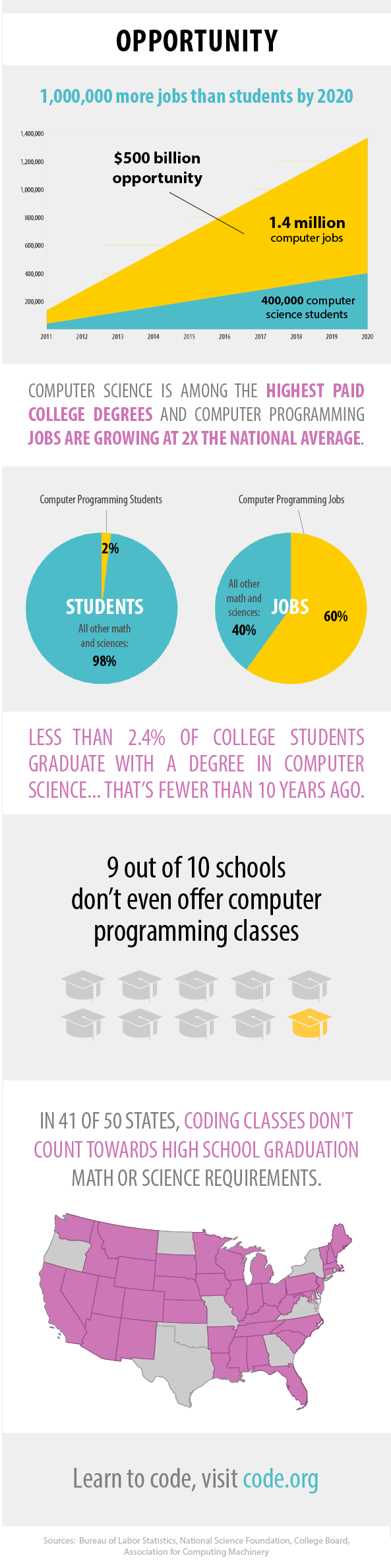
More Perspective and Perspective from Mozilla in this video. Coding, Scouting, and Camping compared….a powerful idea.
